
Televizijski formati kao sadržaj koji generišu korisnici: Jutjub kao mas-medijski kanal influensera

Apstrakt
Profesionalizam u kreiranju medijskih poruka više se ne smatra ekskluzivom masovnih medija. Vremenom, zbog sve većeg interesovanja za gledanje video sadržaja na mreži, Jutjub kanali su se odmakli od amaterskih kućnih videa ka kvalitetnijoj produkciji. S obzirom na ove promene, zanimljivo je videti kako jutjuberi doprinose evoluciji medijskog sadržaja i televizijskih formata posebno. Ispitivanjem i analizom brojnih Jutjub kanala ovo istraživanje pokušava da utvrdi na koji način su jutjuberi usvojili televizijske formate i kako su jutjuberi, posebno oni koji se smatraju influenserima, promenili principe pravljenja audio-vizuelni sadržaj.
Članak
INTRODUCTION
It has been mentioned many times before that the internet, especially since Web 2.0 emerged, requires a new approach to how media is perceived, and that interpersonal and mass media communication can no longer be treated separately. Development of social networks along with the term viral has especially contributed to this attitude, since users of social networking platforms may find themselves in a situation where their message can be treated as interpersonal communication, but virality can turn it into becoming a mass media message received by numerous users of the World Wide Web. The terms such as viral, as well as the notion of bigger or less big numbers of followers or subscribers are very often related to the other term which is nowadays embedded in the idea of social media networks – influencers, users who have some sort of impact when it comes to their community and beyond. According to some dictionaries, an influencer is a person who has the power, inspires and/or drives the actions of others or generates the interest in something by talking about it on social media (Oxford Learner’s Dictionaries; Dictionary.com; Merriam-Webster dictionary). In these dictionaries and definitions, an influencer is also very much related to promotion of brands and marketing. However, this cannot be considered as a full description of this phenomenon, and it often means much more than that, since a social media user cannot become an influencer over night and as such start persuading other social media users to buy a product or use a service. In fact, the idea of building a community on a social media and other aspects other than marketing segment requires wider research which cannot be elaborated in one single paper.
Going back to the topic of this research, it can be said that social media influencers are in the first place content creators who play a significant role in the way the media is understood today. In that sense, this research pays special attention to YouTube users due to the complexity of the media messages they produce. For almost two decades, YouTube has been researched from the standing point that it inherited, as stated by David McQueen (McQueen, 1998: 3), previously the most popular mas media channel – television. Being called Television 2.0 (van Dijck, 2007) YouTube has already been viewed many times as the new stage in the future of television. In some ways, this idea could be disputed simply because YouTube is a streaming platform on the internet and as such part of the new media while television is a traditional mas media channel. This means that the difference in terms
of technical and technological standards of two are not comparable. However, if the internet, as a new medium, is viewed in terms of the extension and evolution of traditional mass media, then these relationships and comparisons should be sought more in the content rather than technology.
When it was created, YouTube looked like a virtual place where users of this platform would be able to post videos that would not exceed the quality of former home videos recorded by VHS or armature small digital cameras. In an interview with Charlie Rose1, two (out of three) co-founders Chad Hurley and Steve Chen talked about the beginnings of YouTube and revealed that after one dinner party in January of 2005 where people were taking photos and videos, three of them came across the idea to establish a network which would facilitate sharing video clips between its users since they realized that comparing to sharing photos, video sharing was encountering a few technical difficulties.
The first ever video (Taylor, 2015) titled Me at the Zoo2, which was uploaded on April 24th, 2005 by Jawed Karim, the co-founder of YouTube, was nothing more than 18 seconds video of Jawed talking about elephants’ long trunks3. Little did they know that only a year and a half after this historical video was posted, another video message would be sent by the co-founders of this platform.
In that video4, uploaded on October 10th, 2006, Steve and Chad announced that the site was acquired by Google and that in the years to come this platform would be transformed into the one of the biggest streaming platforms on the internet. In the meantime, accounts were turned into channels where millions of users were making and posting video clips for various reasons. In less than two decades, YouTube as a platform for user generated content played a major role in shifting the idea of public communication and media in general.
In the meantime, following the rise of YouTube (as well as blogs and other social media websites), traditional media by adopting the convergent model became a user between the millions of others, fighting for their (users’) attention as any other youtuber.
With social media platforms to which YouTube belongs, users are no longer the consumers of media content, but also producers (Stokel-Walker, 2021: 13), and as of the beginnings of Web 2.0 anyone with digital camera, smartphone and/or computer is able to produce their own audio-visual content and distribute it from their homes to a large audience (van Dijck, 2007).
In the meantime, users of YouTube platform, especially those with large number of subscribers5 and views6, supported with technology offered by the platform itself had developed a specific approach to video making process as well as structure and essence of the content. Some authors believe that the style of filming is one of the main aspects that distinguishes Youtubers from classic media (Stokel-Walker, 2021:9)
While watching numerous videos on YouTube, the visitor can notice the general style in which Youtubers address to their audience by looking straight at the camera. This, as Stokel-Walker considers as Youtuber style, is not completely new, because it actually relies on the television style, where a presenter or commentator would address the audience, shot in close-up, also looking directly at the camera. Among the content that can be found on YouTube, very often the users will find vlogs as popular formats where the authors film with handheld cameras with very little or no additional lights, while finding themselves in certain situations that they consider interesting for their viewers. It can be said that this is, another way of
recording videos, which is also not unique nor exclusively related to this platform. On the contrary, the vlogs in their aesthetics very much resemble the technique which is used to shoot cinema verité documentaries.
Considering these and other similarities van Dijck (2007) for example, in the early days of YouTube, acknowledges that this platform is not forcing conventional television programming to become obsolete, but rather depends on the use of customary practices of broadcasting, and even after so many years after he published his assumptions, the same conclusion stands.
With all that in mind, it can be said that at the beginning, the major difference that YouTube brought was the ability to disseminate the message in ways that did not require a large TV studio, infrastructure, the expensive technology, production nor logistics required even by the smallest television station. Also, YouTube has enabled the rise of influencers as new type of media content producers who have started to use old, well-known techniques and formats in a slightly different way.
1 https://www.youtube.com/watch?v=7E6E9q8Jebw
2 https://www.youtube.com/watch?v=jNQXAC9IVRw
3 As a true historical artefact that testifies one of the biggest moments in the history of Web 2.0 this video has never been deleted and currently counts 231,576,445 views.
4 https://www.youtube.com/watch?v=QCVxQ_3Ejkg
5 Subscribers on YouTube represent number of users following particular account also known as channel
6 Each video posted on YouTube has a counter which will register each view coming from single IP address in 24 hours. This counter might be switched off so that visitors of the channel cannot see it. Also, each channel in the About section shows a number of collective views for all videos posted on that channel.
YOUTUBE: SOCIAL MEDIA
At the beginning of this paper, a short history of YouTube was mentioned, where it was said that its creators started this website with the idea of enabling the exchange of video files that were otherwise difficult to be sent by e-mail or other channels previously known on the internet. A network of users who were able to post their videos, but also to access content posted by others was created.
Similar to (then) already popular network – Facebook, the content was interactive, so users were able to like each other’s posts, leave comments and share with their circle of friends on other networks what they found interesting, fun or in any other way, worthy of attention.
In his book Digital Media & Society, Simon Lindgren (Lindgren, 2017: 31-32) looks at Gauntlett’s conclusions about YouTube being social media platform as it meets three requirements. Firstly, he emphasizes YouTube as a framework for participation, as a wide range of different types of videos are uploaded by different types of users ranging from poets to medics to engineers and artists and so on, and this variety shows as this is “just” one more platform which does not indicates what type of content should be published. Technologically, it also promotes the rules and patterns of interactive behavior (likes, shares, comments) as well as following curtain policies such as copyrights, prohibited explicit content etc. Second, the
platform is content-agnostic which generally means that YouTube does not care or knows about the content that has been uploaded as long as it meets policies and standards that are set. In other words, it doesn’t matter if the uploaded content is about professional features or a story of an “ordinary” person. The third aspect that was introduced is that the platform has community features which again means that users can connect and communicate in order to promote their own videos where they promote their skills, share knowledge or entertain others.
In support of the fact that YouTube is social media platform, Lindgren also points out that YouTube is a virtual place where users “connect by interaction” in order to form groups and build society (Lindgren, 2017: 31-32).
As a social media platform, YouTube offers content creation and content seeking as two major functions for their users where content seeking represents intuitive user-action that allows users to browse and search for specific videos for individual gratification, while with content creation, users are able to create and share their own video content (Balakrishnan & Griffiths, 2017: 364). It also has unique architecture, norms and culture which distinct this platform from other social media websites, which offers various ways of how YouTube is being utilized, not only for entertainment or learning, but also for possibility for social interaction in forms of comments, and as mentioned, seeking and providing information (Khan, 2017: 237). Besides these points, the fact that also sets YouTube apart from other social media is, that, from the beginning, YouTube has been actively engaged in a convergence between tech industry and media industries` ways of thinking and operating (Burgess & Green, 2018: 4) which definetly brought together the idea how the creation of the content was developed from the early stages and amatur videos to a highly developed, organized and produced content.
YouTube is also a digital ecosystem which also represents probably the most lucrative platform for the creators among all social media networks. According to Derral Eves, this system works according to the following pattern: creators make videos and upload them to YouTube; the attention drawn by this content makes it appealing to the brands and companies and YouTube runs the advertisements in various forms alongside the uploaded videos; when the channel meets ad sharing program7 requirements, the channel/author(s) gets the cut of the money from those ads running with their content; companies also can pick and choose channels and creators who they think would be able to increase the awareness about their
brand and partner up for further cooperation (Eves, 2021: 9-10). This type of business philosophy introduced by Google8 makes this platform even more interesting for content creators which further results in the increase of channels and content, which in return creates more interest of those content seekers.
Having in mind all previous points, it can be said that YouTube is one of the most attractive platforms for creating (audio-visual) content. Therefore, it is not surprising that a large number of users have developed their skills for this environment, and that due to interests of others, a large number of them achieved their status as influencers.
7 The YouTube Partner Program allows creators to monetize their content on YouTube.
8 The YouTube Partner Program is based on Google Ads program which was established on the similar principles but focuses on other types of websites.
YOUTUBE: INFLUENCERS
The definition of an influencer (in the virtual world) that was previously mentioned in this paper could be further expanded, so it can be said that the influencer is a person who has the power to influence the attitudes and decisions of others because of his (un)justified authority, position and/or knowledge through their activities on social media networks. Online influencers are usually very active on social networks and have a slightly longer list of those who are interested in these activities. Therefore, very often, in public debates, it happens that the influence of a person on the internet is wrongly measured exclusively by the number of those who “follow” or “subscribe” that person’s account or channel on social media
platforms. This fact should actually be defined primarily as popularity, which does not necessarily mean influence, but it is certainly an important characteristic of every influencer on social media (Ercegovac, 2017: 253). The process of becoming an influencer usually reflects the interaction with other users of these platforms which happens more often than among other, “regular” users (Lou, 2021; Schouten, Janssen and Verspaget, 2020). They communicate not only with their subscribers or followers, but while climbing the stairs towards their influence, those users would include in their communication process other users who they believe can add value to the context of their messages. For example, users who are trying (deliberately or not) to reach influencer status at some point will not only respond to other user’s comments left under the content they were posting but will also “tag” users from
whom they themselves expect some reaction and then further interaction. This process then allows users to develop greater visibility on the network which they are using, attract more attention and increase the likelihood of reaching influencer status at some point.
Speaking of the internet and Web 2.0, virtual space has become not only a source of information but also a place where, thanks to platforms for user-generated content, such as social media – people are discussing different information, news, events, and even products (Ercegovac, 2017: 256). According to Two-step flow theory9, social media as the place for communication, plays an important role in the transmission of information and reinterpretation of media content, as well as influence on other members of the group when it comes to understanding the meaning of media messages that are reinterpreted.
That means that social networks are radically changing the way users and consumers receive information, news and opinions, but as in the case of traditional media, online social media are also the place where the great influence comes from so-called opinion leader (Gangadharbatla & Valafar, 2017). As prominent members who are in a sense on top of the hierarchy of the online community, influencers have taken on that role and are considered to be opinion leaders.
Simon Lindgren points out to digital communications researcher Mathieu O’Neil as one among those who are emphasizing the fact that the internet is full of hierarchies, not only because online networks are often scale-free, but more importantly, because the authority is a very important element of the social interaction in online communities. O’Neil further claims that participants involved in social media interaction need to exercise a kind of quality control over their actions and the way how they organize their activities, which means that online
organization cannot exist without hierarchy. Also, he is arguing that there is an issue of trust and reliability, where participants also need to determine who is reliable and who is not, and understand which contributions are relevant and important. By building this trust, it will help users to decide who should be a part of the group and who should be excluded. Lindgren further says that O’Neil’s explanation of how authority is built in an online community, despite “of the ‘stateless’ character of the internet, lies in his notion of online tribes. Such tribes are online formations based on direct forms of grassroots democracy, and on a feeling of closeness to others. But, because of the reasons presented above, authority is still an important dimension of such tribes.” (Lindgren, 2017: 167)
Going back to YouTube and influential users on this platform, it is very interesting to see how they are using their “power” to make an impact on those who are watching their videos. That can be established by determening the categories and topics of the content which are covered while they are addressing the audience.
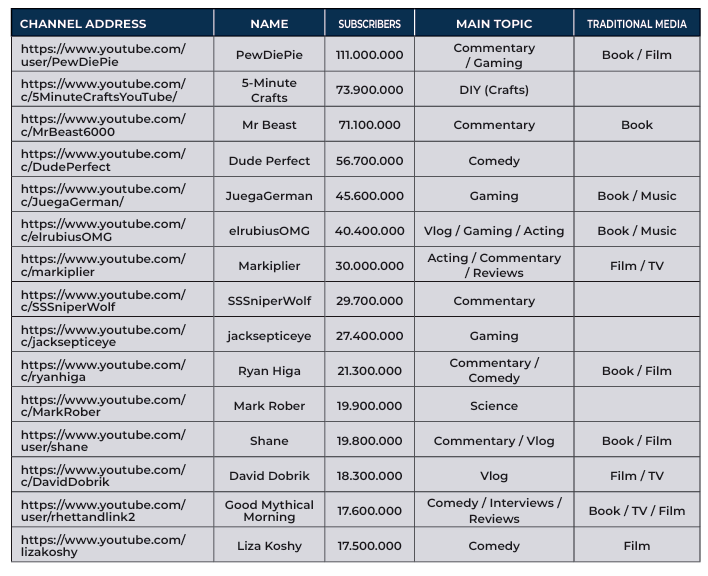
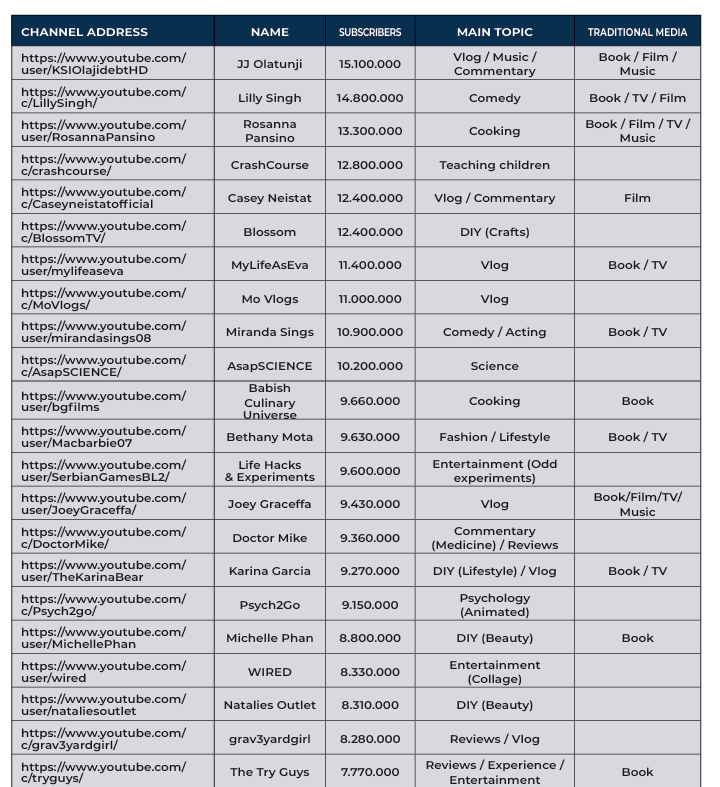
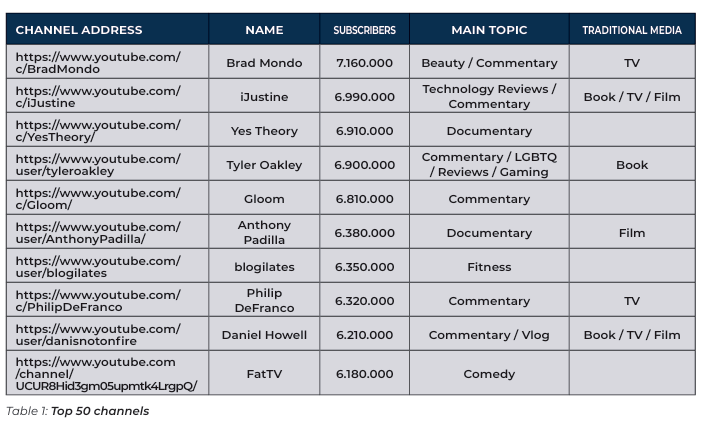
Out of around 250 randomly chosen YouTube channels created by individuals 10 which were being analyzed for the purposes of this research, the first, most popular 11 hundred accounts are covering topics in a range of categories from gaming, entertainment and news about celebrities, over fashion, beauty, cooking and lifestyle to pranks and comedy, tutorial, hacks, education and science, health and fitness to commentary and reviews. Most of the channels, however, are covering more than one category.
In solid numbers the sample shows that most popular category is commentary where 31 channels are either completely or partially commenting various topics.
However, none of the political commentators entered top 100 (Table 1 shows top 50 channels). This number is showing that individual users/content creators want to speak their minds on various topics and the fact that they gained so much interest in terms of subscribers shows that they do have the audience that is interested in hearing that opinion. This also corelates with Two-step flow theory and the idea that influencers are in fact opinion leaders in the online community.
The second most popular category is the vlog with 20 channels where vlogging is the main aspect of content creation. Even though vlogging is a separate category, it also considers some sort of personal experience that content creators are communicating. That, at the end of the day, generates opinion that other users are acknowledging through the journey of watching those videos.
The third most popular type of content is comedy with 13 channels mainly focused on skits and other types of comedian content. Educational content including documentaries is covered by 12 channels, while beauty is covered by 10 content creators. The same number of channels (10) are making their content by reviewing different products or services. Different DYI content is covered by 8 channels, and the same number of content creators on YouTube is covering different aspects of entertainment which do not include music. Lifestyle and fashion each is covered by 6 channels.
Even though the most popular individual user PewDiePie who has over 111 million subscribers gained his popularity with gaming topics, this category in top 100 channels is covered by only 5 content creators. The same number of channels is focused on music. Fitness and health are covered by 2 channels and only one channel that covers the subject of photography and videography entered the top 100 list.
Another interesting fact that came out of this analysis is that top 100 channels is dominantly run by male content creators with 61% accounts. Female content creators are taking 34% of the portion and 5% are made by mixed gender group of people.
Further to this analysis, when it comes to understanding the impact of YouTube influencers, contributes the story which was brought up in Derral Eves’ book called The YouTube Formula. In the chapter 8, titled The Real Power of Your Influence: Making a Difference, Eves talks about the good practice of awareness and the responsibility of youtubers when it comes to the power of the(ir) spoken word. He is particularly focused on two stories as examples of his claims, where one of the most popular youtubers MrBeast started two different campaigns, one called Team Trees, where the organization under the same name helps planting trees all over the world. This campaign was supported by many YouTube influencers. Another
campaign organized by MrBeast included 32 other biggest YouTube creators when they decided to raise the money for Covid-19 relief. In the live stream which was also supported by YouTube (and Google) the group of youtubers managed to raise 5.8 million US dollars in a virtual rock-paper-scissors tournament. This amount was topped up with Google’s 12 million dollars donation. (Eves, 2021: 87-91)
When it comes to the production of content that is watched on YouTube today, which is generated by influencers, in the analyzed content, it is noticed that most of them use far cheaper equipment than the one that can be seen in television stations.
On the other hand, there is a much higher degree of creativity during editing and using graphics to make up for these shortcomings. Computer processing is advanced enough that this is possible in many cases. It is also noticed that the use of props in videos on YouTube is more frequent, and that most of youtubers are taped in a somewhat more relaxed atmosphere. Thus, youtubers often film in their homes, so they can usually be seen sitting at their desks, and less often in furnished, more formal spaces that would remind the audience of the studio. This is also one of the reasons why viewers identify with youtubers much more easily than with public figures who they can watch on television.

9 The two-step flow theory is based on the idea that people will shape their opinion based on the influence of opinion leaders, who are previously influenced by mass media.
10 The research is covering only those channels that are created by individuals. Branded channels created by companies, public figures and mass media channels are not considered.
11 Most popular according to the number of subscribers.
YOUTUBE: MASS MEDIA
Another aspect of this paper, as mentioned at the beginning, is the relationship between YouTube content and mass media and television in particular.
In 2008, Andrew Keen, an English digital media entrepreneur wrote a book titled The Culture of Amateur, where he criticized the Web 2.0 structure, stating that websites like social media, Wikipedia and other user generated content (UGC) media are destroying culture, economy and values (Keen, 2008: 1). Talking about YouTube specifically he stated that at that time, it was world’s fastest-growing site – a portal of amateur videos which was attracting sixty-five thousand new videos daily with sixty million clips being watched each day which overshadows the blogs in the “inanity and absurdity of its content”. For him there was nothing too prosaic or narcissistic for “these videographer monkeys”. Keen also thought that YouTube represents a site which is endless “gallery of amateur movies showing poor fools dancing, singing, eating, washing, shopping, driving, cleaning, sleeping, or just
staring into their computers”. (Keen, 2008: 5) He was pointing out that YouTube along with other social media is a place for spreading misinformation and fake identities (2008: 75-79). Essentially, through the book he wrote, Keen expressed his standing point that Web 2.0 and UGC websites negate the professionalism and allow the rise of amateur culture, where everybody can be free to publish whatever they want without any control, and he was not alone having these thoughts. As so many times before, there were those who believed that the rise of the new media is bringing the downfall of the mankind destroying culture and values of the previous times.
Having known the quality and practice of what YouTube was all about, in some ways, Keen was right and accurate in describing the platform that just started developing. However, things did naturally change and what YouTube has to offer nowadays has none or very little resemblance to what it was in the early days. The fact that the platform gained so much interest from the content seekers, made a push within the content creator side, making them strive towards better content not only in terms of production, but also in terms of the essential quality of the topics, approach, research as well as the way how the storytelling was developed. Truth be told, in the wide spectrum of video content that can be found on YouTube, there is still a number of videos that are not meeting any professional standards. However, when it comes to the production of content creators who are considered to be at least popular if not influential, the image of YouTube is much further from Keen’s idea as it could be.
Having said that, it should be emphasized that scholars like Amanda Lotz have a different belief. For instance, she claims that YouTube is a version of self-created television, which is actually a forum of expression in which viewers communicate with each other by sharing their television. (Lotz, 2014: 49)
In her book, Television Will Be Revolutionized, she is pointing out to the possibilities and opportunities that this platform is offering in the “post-network era” corroborating her thought with some strong examples to prove her point (Lotz, 2014).
During the analysis of already mentioned YouTube channels, several examples have emerged that speak in favor of Lotz’s statements. One of the well-known youtubers Mark Fischbach, better known as Markiplier has developed his own production of fictional stories, or better, short films and series which brought him the attention of around 32.8 million subscribers and approximately 18.1 billion views. Another youtuber, Liza Koshy, after her sole success which she gained making comedy skits and vlogs, eventually partnered up with the platform itself and created a popular, high-budget series called Liza on Demand. In the meantime, Liza also made and posted on her channel several interviews with public figures such are Barack Obama, Will Smith, Met Gala Red Carpet interviews in 2019 and others. The group of youtubers gathered around the channel called Beta Squad regularly produces content in forms of a show which combines reality TV with game show, while Omar Farooq makes series of documentaries discovering different places and people. Scotty Kilmer also creates his content which stands neck-a-neck with TV shows such as The Grand Tour, Top Gear, Wheeler Dealer and others car related shows and series. Apart from making very cinematic videos about photography and videography, Peter McKinnon also features documentaries and commentaries, sharing his personal thoughts and experience. Sam Chui talks about traveling and aviation, and his content could be easily broadcasted on channels such as NatGeo People or any other TV channel with similar structure.
In terms of users and usage, YouTube seems to be very different from television. However, the first cannot be seen separately from the other as video-sharing, as social practice which is promoted by this UGC platform, evolves in close connection to the common activity of watching television, even if the two leisure experiences, at first, seemed to have not too much in common. (van Dijck, 2013: 153)
Additional conclusion from the analysis of YouTube channels is that in top 100 YouTube channels, more than half of the content creators, 58% to be exact, after gaining the success on YouTube, has reached for the experience in traditional media (or vice versa). In fact, 31 content creators have started their parallel careers in film or television, but interestingly enough, 41 youtubers from the list of top 100 have published books.
YOUTUBE: CONCLUSION
Analyzing the channels of influencers from YouTube, it can be concluded that the current image of this platform is more than a good indicator that the creation of content in this community is increasingly turning to quality production that resembles more media messages previously found only on television. Since the interest in youtubers and what they have to say is growing, it can also be said that not only because of the quality, but also the viewership, this platform has long gone beyond amateurism, and that the entire network can be seen as a set of channels whose together influence is to be seen as a mass media system. What still distinguishes YouTube from traditional media is not only the technical and technological aspect, but also the freedom to edit and run these, one might say, programs. The platform itself prescribes certain rules, in terms of privacy, copyright, hate speech and all types of discrimination, but in many ways, these regulations do not restrict creators but protect and motivate them and push them towards the quality.
What was not covered by this research is another technological aspect in terms of “winning” over the ever-changing algorithm and the way creators align with such innovations. This fight is also a factor that once again separates YouTube from the traditional media, which in other ways fight for the viewership and attention of the audience. This aspect is definitely a potentially challenging area that could be considered for further research and analysis.
Reference
2. Burgess, J. & Green, J. (2018): YouTube; Cambridge: Polity Press.
3. Ercegovac, I. (2017): Influencers as Opinion Leaders in Primary Groups on Social Media and Their Roles in New Media Sphere, Godišnjak Komunikacije, mediji, kultura, 9(9), pp. 251-268; Beograd: Fakultet za kulturu i medije.
4. Eves, D. (2021): The YouTube Formula; Hoboken, New Jersey: Jihn Wiley & Sons.
5. Gangadharbatla, H. & Valafar, M. (2017): Propagation of user-generated content online, International Journal of Intenet Marketing and Advertising, 11(3), рр. 218-232; Geneva: Inderscience Publishers.
6. Keen, A. (2008): The Cult of the Amateur; Boston: Nicholas Brealey Publishing.
7. Khan, L. (2017): Social Media Engagement: What Motivates User Participation and Consumption on YouTube? Computers in Human Behavior, 66, рр 236-247; Amsterdam: Elsevier.
8. Lindgren, S. (2017): Digital Media & Society; London, United Kingdom: SAGE.
9. Lotz, A. D. (2014): Television Will Be Revolutionized; New York: New York University Press.
10. McQueen, D. (1998): Television; London: Arnold.
11. Schouten, A. P, Janssen, L. & Verspaget, M. (2020): Celebrity vs. Influencer endorsements in advertising: the role of identification, credibility, and Product-Endorser fit, International Journal of Advertising, 39(2), рр. 258-281; Oxfordshire: Routledge.
12. Stokel-Walker, C. (2021): Youtubers; Kingston upon Themes: Canburry Press.
13. van Dijck, J. (2007): Television 2.0: YouTube and the Emergence of Homecasting, Media in Transition 5: creativity, ownership and collaboration in the digital age; Boston: MIT.
14. van Dijck, J. (2013): YouTube beyond technology and cultural form, in M. de Valck, & J. Teurlings, After the Break - TELEVISION THEORY TODAY, pp. 147-160; Amsterdam: Amsterdam University Press.
WEBOGRAPHY:
1. Jawed K. (2005): Me at the Zoo (https://youtu.be/jNQXAC9IVRw, visited 8/5/2022)
2. Lou, C. (2021): Social Media Influencers and Followers: Theorization of a Trans-Parasocial Relation and Explication of Its Implications for Influencer Advertising. Journal of Advertising (https://doi.org/10.1080/00913367.2021.1880345).
3. Rose, Ch. (2006): Preview of interview with YouTube Co-founders|Charlie Rose, (https:// youtu.be/7E6E9q8Jebw, visited 8/5/2022).
4. Taylor, J. (2015): The 10 Most Important Videos in YouTube History (https://observer. com/2015/02/the-10-most-important-videos-in-youtube-history/, visited 8/5/2022)
5. YouTube (2006): A Message From Chad and Steve (https://youtu.be/QCVxQ_3Ejkg, visited 8/5/2022)
Objavljeno u
Vol. 2 broj 3 2022.
Ključne reči
🛡️ Licenca i prava korišćenja
Ovaj rad je objavljen pod Creative Commons Attribution 4.0 International (CC BY 4.0).
Autori zadržavaju autorska prava nad svojim radom.
Dozvoljena je upotreba, distribucija i adaptacija rada, uključujući i u komercijalne svrhe, uz obavezno navođenje originalnog autora i izvora.
Zainteresovani za slična istraživanja?
Pregledaj sve članke i časopise