
From Waste to Wear: An Exploratory Factor Analysis of Italian Consumers’ Acceptance of Food Waste-Based Textiles

Abstract
Food waste fashion applies circular economy principles to transform food industry by-products – such as citrus peels and grape skins – into innovative textile fibres. As a sustainable alternative to fast fashion, it addresses the sector’s environmental impact and promotes ethical consumption. While industry and media attention is increasing, academic research remains scarce, especially regarding consumer responses. Most existing studies focus on technological or environmental metrics, neglecting emotional and symbolic aspects of consumer behaviour. This study investigates Italian consumers’ perceptions of garments made from food waste, aiming to fill this gap. Data were collected via an online survey, and Exploratory Factor Analysis (EFA) was used to identify underlying dimensions shaping attitudes. Findings reveal that openness to food waste fashion is influenced by sustainability values, perceived novelty, and concerns about materials. These insights contribute to circular fashion literature and provide actionable guidance for managers seeking to enhance consumer engagement with bio-based innovations.
Article
INTRODUCTION
The global fashion industry is increasingly criticised for its environmental and social impacts. As a highly resource-intensive sector, it contributes significantly to water use, carbon emissions, and waste generation. Fast fashion, in particular, exemplifies the unsustainable “take-make-dispose” model, promoting rapid production, low durability, and excessive consumption. It generates over 92 million tonnes of textile waste annually and perpetuates social inequalities within global supply chains (Niinimäki et al., 2020; Bick et al., 2018). In response, sustainable and circular fashion models have gained traction. These approaches aim to minimise environmental harm, extend product lifecycles, and repurpose waste into new resources (Schiaroli et al., 2025). One innovative development is food waste fashion, which transforms agricultural by-products – such as citrus peels, grape skins, and coffee grounds – into alternative textile fibres. This practice addresses sustainability challenges in both fashion and agrifood systems by reducing landfill waste and decreasing reliance on virgin materials (Chi, 2015; Shen, 2014; Provin and de Aguiar Dutra, 2021). Interest in food waste fashion is also growing among environmentally conscious younger consumers (Joy et al., 2012). However,enthusiasm does not always translate into action. Research has consistently highlighted the attitude–behaviour gap in sustainable fashion, whereby consumers support sustainability in principle but fail to reflect these values in their purchasing decisions (McNeill and Moore, 2015). Several barriers contribute to this disconnect. Consumers often prioritise price, convenience, and brand familiarity over environmentalattributes (Achabou and Dekhili, 2013). Moreover, in the case of food waste-based garments, scepticism about quality, hygiene, and material unfamiliarity may hinder adoption. Recycled and upcycled fashion is still often perceived as lower in quality or less fashionable (Henninger et al., 2016), which can deter even sustainability-oriented consumers.
Despite these dynamics, there is a notable lack of academic research specifically focused on consumer attitudes toward food waste fashion. Existing studies tend to examine broader categories like “eco-fashion” or “sustainable textiles,” overlooking the unique challenges and perceptions linked to garments derived from food by-products (Thorisdottir et al., 2024). The Italian context, in particular, remains underexplored, despite its leadership in both the fashion and agri-food sectors. Understanding Italian consumers is especially relevant given the country’s cultural affinity with both industries and its strategic potential for circular innovation. To address this gap, the present study investigates Italian consumers’ awareness, perceptions, and behavioural responses to food waste fashion. Using an online survey and Exploratory Factor Analysis (EFA), it identifies the main drivers and barriers influencing engagement. The study aims to offer theoretical contributions to circular fashion
research and practical insights for brands and policymakers seeking to promote more sustainable consumption behaviours.
THEORETICAL BACKGROUND
The environmental and social impacts of the fashion industry have spurred increasing academic and institutional attention to alternative production and consumption models. The dominant fast fashion paradigm, based on rapid production cycles, low-cost materials, and planned obsolescence, has been identified as a major contributor to global environmental degradation. It accelerates water use, energy consumption, chemical pollution, and generates vast volumes of textile waste – estimated at over 92 million tonnes annually (Niinimäki et al., 2020). Furthermore, it reinforces exploitative labour structures within international supply chains (Bick et al., 2018). These systemic issues have prompted calls for a shift toward circular and sustainable fashion models. Circular fashion, grounded in circular economy principles, aims to decouple fashion production from virgin resource extraction and waste creation. It promotes strategies such as reuse, recycling, upcycling, and the incorporation of bio-based or waste-derived inputs (Schiaroli et al., 2025). Within this framework, food waste fashion represents a novel and promising innovation. This emerging segment involves transforming agricultural and food industry by-products – such as citrus peels, grape skins, and coffee grounds – into textile fibres suitable for apparel and accessories. It not only diverts organic waste from landfills but also reduces dependence on synthetic and virgin fibres, thereby lowering the environmental burden of both the fashion and agri-food sectors (Chi, 2015; Jung & Jin, 2014; Shen, 2014; Provin & de Aguiar Dutra, 2021). Prominent cases like Orange Fiber, an Italian start-up that produces fabrics from citrus waste and collaborates with luxury brands, show that such innovations can merge sustainability with aesthetic and commercial appeal (Gain et al., 2024; Karaosman et al., 2020). These examples highlight the market potential of food-derived textiles, particularly when supported by strong narratives of ethical production, technological innovation, and design excellence. The convergence of sustainability and style resonates especially with younger, environmentally conscious consumer segments, including Millennials and Gen Z, who tend to value authenticity, ethical alignment, and social impact in their purchasing decisions (Joy et al., 2012). Nonetheless, a persistent challenge in sustainable fashion adoption is the well documented attitude-behaviour gap: while consumers frequently express concern for environmental issues and claim to support sustainable products, this does not consistently translate into actual purchasing behaviour (McNeill and Moore, 2015). Various studies have shown that
factors such as price sensitivity, limited product availability, and low trust in sustainability claims can act as barriers to adoption (Achabou and Dekhili, 2013). Moreover, in the specific case of upcycled or waste-based fashion, additional psychological and symbolic factors come into play. Consumers may question the quality, hygiene, and performance of garments made from waste materials or associate them with unattractive aesthetics and lower status (Henninger et al., 2016). These perceptions may conflict with the desire for fashionable, high-quality clothing and can inhibit consumer engagement.
Despite growing interest in food waste-based textiles, academic research remains limited, particularly on the demand side. Most existing studies prioritise the technological development and environmental assessment of innovative materials, with far less emphasis on the social, symbolic, and behavioural dimensions of consumer responses (Thorisdottir et al., 2024). Where consumer research does exist, it tends to treat sustainable fashion as a broad category, often neglecting the specific material origins of garments, which are likely to influence perceptions in distinct ways. For instance, recycled plastic fibres may evoke different concerns and expectations than fibres derived from fruit or vegetable waste. Furthermore, the Italian context offers unique conditions for studying consumer engagement with food waste fashion, yet it remains underexplored in the literature. Italy is a global leader in fashion design, luxury branding, and craftsmanship, as well as a major producer of agricultural outputs such as citrus fruits and grapes – both of which are already being used in food-to-fashion innovation. This intersection of cultural, economic, and environmental relevance makes Italian consumers a particularly meaningful case for understanding the social acceptance and symbolic legitimacy of circular fashion models. There is also a growing need to examine how digital ecosystems – including online platforms, influencer marketing, and brand-led sustainability communication – shape consumer awareness, trust, and acceptance of such innovations. Consumers are increasingly exposed to sustainable fashion messaging through social media, where transparency, storytelling, and aesthetic appeal all play crucial roles in building credibility and engagement. However, little is known about how these digital interactions influence the reception of biobased, waste-derived materials in particular.
To address these knowledge gaps, this study focuses on three key research questions:
RQ1: What are the main drivers and barriers affecting Italian consumers’ engagement with food waste fashion?
RQ2: How do sustainability values and innovation-oriented attitudes shape perceptions and adoption of garments made from food-based fibres?
RQ3: What role do digital platforms and brand communication play in fostering awareness and acceptance of food waste-based textiles?
METHODOLOGY AND DATA
To address the study’s objectives, a quantitative approach was adopted through an online survey targeting Italian consumers. The primary aim was to investigate perceptions, values, and barriers associated with garments made from food-derived materials, contributing to a better understanding of consumer engagement with circular fashion. The questionnaire combined five-point Likert scales, multi- ple-choice, and open-ended items and was informed by existing literature on sustainable consumption, green innovation, and circular textiles. A pre-test ensured clarity and internal consistency. The final version was distributed via Google Forms between August and September 2024, collecting 421 valid responses.
The survey was structured into four sections. The first explored general fashion purchasing behaviour, including frequency, channel preferences (online/offline), and the influence of price, quality, and aesthetics. It also assessed familiarity with sustainable fashion, considered a key factor in shaping pro-environmental choices (Niinimäki et al., 2020). The second section examined awareness and perceptions of sustainable materials, such as hemp and linen, extending to textiles derived from food waste. Drawing on Henninger et al. (2020), it assessed willingness to buy and pay for garments made from food waste, and motivations such as environmental concern or interest in innovation. The third section focused on the role of digital media and communication. Based on work by McNeill and Venter (2019), it analysed preferred information sources, responsiveness to sustainability messages, and the influence of branding and influencers on consumer decisions. The final section gathered socio-demographic data to allow segmentation analysis.
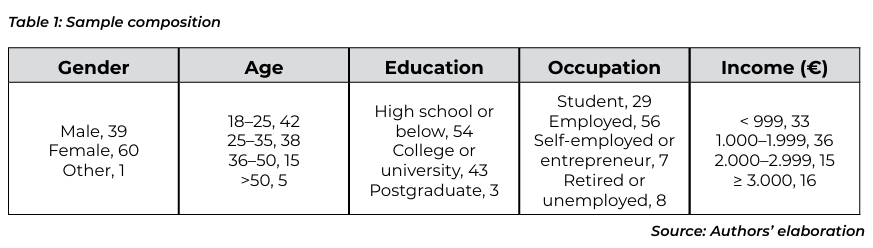
Table 1 outlines the socio-demographic profile of the sample. The gender distribution shows a female majority (60%), followed by males (39%) and 1% identifying as non-binary or preferring not to answer. The sample is predominantly young, with 42% aged 18-25 and 38% between 26-35. Respondents aged 36-50 make up 15%, while only 5% are over 50. Educational levels are mixed: 54% completed secondary education or less, 43% hold a university degree, and 3% have postgraduate qualifications. Employment status reflects early career stages, with 56% employed, 29% students, and 15% self-employed, unemployed, or retired. Income distribution is diverse: 33% earn under €999/month, 36% between €1,000–1,999, 15% between €2,000–2,999, and 16% over €3,000. The majority of respondents are based in the Apulia region, offering useful territorial insight. Overall, the sample is youthful, moderately educated, and economically varied, thus providing a relevant foundation for investigating consumer attitudes toward food waste fashion and broader circular fashion innovations.
RESULTS
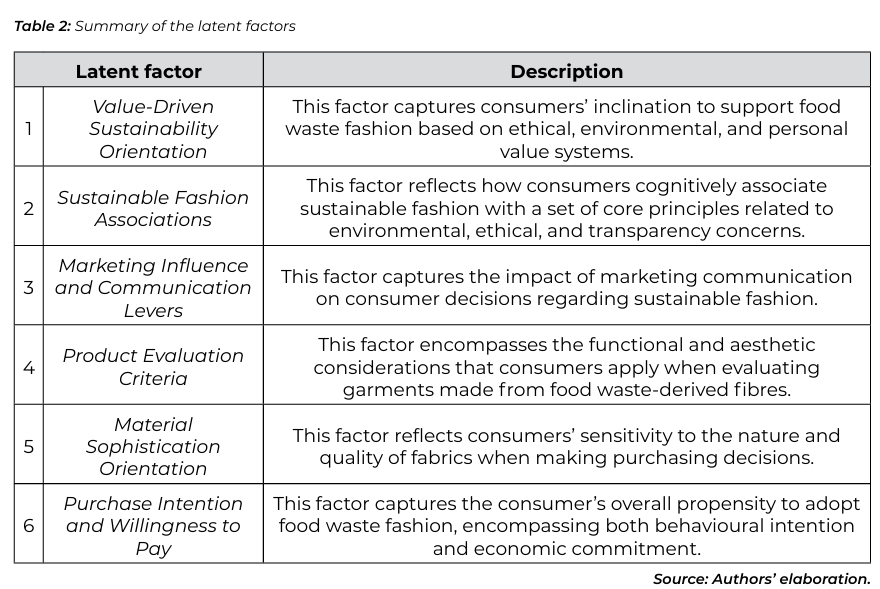
An Exploratory Factor Analysis (EFA) was conducted using IBM SPSS Statistics to identify the latent dimensions shaping Italian consumers’ attitudes and behaviours toward food waste fashion (Abdi & Williams, 2010). Correlation analysis confirmed the relevance of all variables while the dataset’s suitability was validated through the Kaiser-Meyer-Olkin (KMO) test and Bartlett’s Test of Sphericity (BTS). In particular, the KMO value exceeded 0.7 and the BTS was statistically significant (p < 0.05), indicating strong sampling adequacy. Next, communality values showed satisfactory variance explained, with 67.33% of total variance accounted for. Based on these results, six latent factors were extracted. A summary of these factors is provided in Table 2.
DISCUSSION AND CONCLUSION
This study provides a comprehensive understanding of the factors shaping consumer engagement with food waste fashion, revealing a complex interplay between sustainability values, product-related expectations, and communication dynamics. The first factors indicates that consumers assess garments made from food-derived fibres primarily through an ethical and environmental lens. Therefore, transparency, innovation, traceability, and alignment with personal beliefs emerge as critical evaluative criteria, confirming that consumption is increasingly guided by non-material motivations. This dimension is further reinforced by a cognitive mapping of sustainability principles – such as fair labour, responsible consumption, and the use of eco-materials – which consumers readily project onto this emergingniche. These findings suggest that food waste fashion is not perceived as an isolated innovation, but rather as an extension of broader sustainable fashion values. In relation to RQ1, this highlights that core drivers are both ideological – i.e., rooted in personal and social ethics – and cognitive, grounded in established perceptions of what sustainable fashion entails.
However, these are not the only variables of the equation. Consumers also respond to external stimuli, as revealed by the Marketing Influence
and Communication Levers factor. Social media, influencer endorsement, brand storytelling, and sustainability messaging play a central role in shaping awareness, desirability, and trust – especially among Gen Z consumers who operate in highly digitalised environments. This finding directly addresses RQ3, suggesting that digital platforms are not just distribution or promotion tools but cultural interfaces where meanings around innovation and responsibility are constructed. Still, pragmatic concerns remain central to consumer decision-making. The Product Evaluation Criteria factor demonstrates that attributes such as price, aesthetics, comfort, and perceived durability significantly influence acceptance. Even the most sustainability-conscious consumers are unlikely to purchase garments that do not meet conventional expectations of quality or usability. These results expand on RQ2, showing that sustainability values shape perception and intention, but must be reinforced by tangible, credible product performance to translate into adoption. Ethical commitment, in this sense, is a filter rather than a guarantee: it sets expectations, but the decision is contingent upon the product satisfying practical standards.
The study also reveals a Material Sophistication Orientation, highlighting that consumers associate refined, innovative, and unusual textiles with uniqueness, design relevance, and personal identity. This suggests strategic potential for food waste fashion to be positioned not only as ethical but also as aspirational, aligning with Gen Z’s desire for self-expression through distinctive products. Finally, the presence of a Purchase Intention and Willingness to Pay dimension reflects the transition from attitude to action, thus confirming that consumers are willing to support food waste fashion when sustainability values, high-quality design, and compelling communica- tion converge.
Together, these six dimensions offer a rich and multidimensional response to the research questions. They show that consumer acceptance of food waste fashion is driven by a synergy of ethical alignment, product integrity, and digital influence – each component reinforcing the others. However, barriers such as lack of familiarity with materials, concerns about performance, and price sensitivity may still hinder broader adoption.
These insights carry relevant managerial implications. First, fashion brands and start-ups must develop value-driven communication strategies that transparently convey the environmental and ethical benefits of food waste-based garments. Certifications, traceability tools, and clear messaging can build trust and differentiate such products in a crowded market. Second, product development should focus on ensuring high standards of design, comfort, and material performance to address the persistent influence of traditional evaluation criteria. Third, digital marketing should leverage influencers, visual storytelling, and interactive formats to normalise and aspirationally frame food waste fashion, particularly for younger, digitally native audiences. Collaborations with designers or artists, limited editions, and pop-up experiences may further reinforce perceived originality and desirability.
Despite the strong insights, this study is not without limitations. The sample, primarily from the Apulian region, may not fully represent the diversity of Italian consumers. Additionally, the reliance on self-reported measures could introduce social desirability bias. Nonetheless, the findings offer a valuable starting point for further investigations into circular fashion behaviours. In conclusion, food waste fashion has the potential to gain traction if it is communicated as both ethically meaningful and functionally reliable, with digital platforms serving as key amplifiers. Brands that successfully align these dimensions will be best positioned to engage Gen Z consumers and drive forward sustainable fashion innovation.
References
2. Achabou, M. A., & Dekhili, S. (2013). Luxury and sustainable development: Is there a match?. Journal of business research, 66(10), 1896-1903.
3. Bick, R., Halsey, E., & Ekenga, C. C. (2018). The global environmental injustice of fast fashion. Environmental Health, 17, 1
4. Chi, T. (2015). Consumer perceived value of environmentally friendly apparel: An empirical study of Chinese consumers. The Journal of The Textile Institute, 106(10), 1038-1050.
5. Gain, A. M., Coote, L. V., & Bonfrer, A. (2024). Conceptualising and measuring consumer perceptions of brand wastefulness. Journal of Brand Management, 31(6), 557-575.
6. Henninger, C. E., Alevizou, P. J., & Oates, C. J. (2016). What is sustainable fashion?. Journal of Fashion Marketing and Management: An International Journal, 20(4), 400-416.
7. Henninger, C. E., Blazquez, M., Boardman, R., Jones, C., McCormick, H., & Sahab, S. (2020). Cradle-to-cradle versus consumer preferences in the fashion industry. Encyclopedia of renewable and sustainable materials, 5, 353-357.
8. Joy, A., Sherry Jr, J. F., Venkatesh, A., Wang, J., & Chan, R. (2012). Fast fashion, sustainability, and the ethical appeal of luxury brands. Fashion theory, 16(3), 273-295.
9. Jung, S., & Jin, B. (2014). A theoretical investigation of slow fashion: sustainable future of the apparel industry. International journal of consumer studies, 38(5), 510-519.
10. Karaosman, H., Perry, P., Brun, A., & Morales-Alonso, G. (2020). Behind the runway: Extending sustainability in luxury fashion supply chains. Journal of Business Research, 117, 652-663.
11. McNeill, L., & Moore, R. (2015). Sustainable fashion consumption and the fast fashion conundrum: fashionable consumers and attitudes to sustainability in clothing choice. International journal of consumer studies, 39(3), 212-222.
12. McNeill, L., & Venter, B. (2019). Identity, self‐concept and young women’s engagement with collaborative, sustainable fashion consumption models. International Journal of Consumer Studies, 43(4), 368-378.
13. Niinimäki, K., Peters, G., Dahlbo, H., Perry, P., Rissanen, T., & Gwilt, A. (2020). The environmental price of fast fashion. Nature Reviews Earth & Environment, 1(4), 189-200.
14. Provin, A. P., & de Aguiar Dutra, A. R. (2021). Circular economy for fashion industry: Use of waste from the food industry for the production of biotextiles. Technological Forecasting and Social Change, 169, 120858.
15. Schiaroli, V., Dangelico, R. M., & Fraccascia, L. (2025). Mapping sustainable options in the fashion industry: a systematic literature review and a future research agenda. Sustainable Development, 33(1), 431-464
16. Shen, B. (2014). Sustainable fashion supply chain: Lessons from H&M. Sustainability, 6(9), 6236-6249.
17. Thorisdottir, T. S., Johannsdottir, L., Pedersen, E. R. G., & Niinimäki, K. (2024). Social, environmental, and economic value in sustainable fashion business models. Journal of Cleaner Production, 442, 141091
Published in
Volume 5, Issue 9 2025
Keywords
🛡️ Licence and usage rights
This work is published under the Creative Commons Attribution 4.0 International (CC BY 4.0).
Authors retain copyright over their work.
Use, distribution, and adaptation of the work, including commercial use, is permitted with clear attribution to the original author and source.
Interested in Similar Research?
Browse All Articles and Journals