Local Authorities at the Forefront of Climate Policy

Lajos Kovács | Tamás Pálvögyi
Submission received: 9 May 2023 / Accepted: 1 June 2023 / Published: 28 June 2023

Abstract

Preparing for and adapting to the impacts of climate change depends fundamentally on local communities, whether in a large city or a small rural area. In many cases, activities, measures and interventions related to mitigation and adaptation are difficult to implement without social cooperation. Today, it is becoming increasingly clear that climate policy measures can be seen as a key to the future success of municipalities. In this paper, we review the strategic basis for municipal climate policies and present a case study of Hungary to illustrate how municipalities’ decarbonization performance can be measured and evaluated. We then present a crucial element of climate adaptation at the municipal level, the vulnerability assessment of drought risk at the county level. We will analyse the municipal adaptation options and then review urban development projects’ climate performance assessment methodology. In the context of municipal climate policy integration, we present a preliminary climate impact assessment methodology for municipal legal and strategic documents. Finally, in conclusion, we summarise the success factors of municipal climate strategies and make recommendations for the implementation of municipal climate strategies.

Article

INTRODUCTION
There is a widespread scientific consensus that humans are significant contributors to causing climate change, notably through the burning of fossil fuels, the expansion of large-scale agriculture, inadequate waste management and some industrial production processes. As a result, the most abundant greenhouse gas in the atmosphere, carbon dioxide, has increased more than one and a half times since the industrial revolution. The atmospheric concentration of other greenhouse gases, such as methane, which has a much stronger warming effect than carbon dioxide, has more than doubled over the last 200 years.
 
The Earth’s average surface temperature has risen by about 0.9°C since the beginning of the 20th century. However, the rate of atmospheric warming is not uniform across our planet. Hungary, for example, has experienced a 1.2°C rise in temperature since the beginning of the last century, exceeding the global rate of change. Hungary is one of the most vulnerable countries in Europe to the likely consequences of climate change: we need to prepare for more heat waves and more extreme water events than at present. However, the adverse effects of climate change will vary from one municipality or region to another, and each locality will adapt to the impacts of climate change in a different way depending on its specific circumstances. For this reason, it is vital to review municipal climate protection responsibilities and develop a municipal climate policy.
 
THE FUNDAMENTALS OF MUNICIPAL-LEVEL CLIMATE POLICIES - HUNGARIAN EXPERIENCES
 
An effective response to the increase in extreme weather events and the spill-over of local adverse impacts can only be achieved through a comprehensive preparedness and adaptation framework, bringing together local governments, the public,local businesses and civil society organizations. Municipal climate action should be linked to other plans in the municipality or region and national and international climate documents. By establishing these links, local authorities can achieve a coordinated assessment of the situation, rapid prevention and the selection and management of effective adaptation options in the face of adverse impacts (IPCC, 2022).
 
The three main pillars of municipal climate policy are decarbonization, adaptation to climate change and awareness raising. All three areas require the development and planning of concrete action plans, the first and increasingly urgent step being the preparation of a municipal/regional climate strategy and the establishment of a local stakeholder forum to prepare decisions. In 2018, a methodological guide for developing municipal climate strategies was produced in Hungary, providing municipalities with a practical “guide” (ACFM, 2018).
 
Since greenhouse gas emissions are primarily linked to the residential sector (household heating, electricity consumption and the use of cars), emissions should be reduced locally. Climate change objectives are interlinked with environmental protection and sustainability objectives in numerous ways and should therefore be included in municipal environmental programs. However, climate change presents not only challenges but also opportunities. The latter can also be considered in local development to make our communities more attractive places to live and offer a better quality of life for their inhabitants. Municipal climate strategies should ideally be a community decision, reflecting the views of a majority of the population, public institutions, business organizations and NGOs. A community-driven climate strategy encourages the municipality to make efforts to protect and adapt to climate change.
 
Another tool for local climate policies is the development of energy-climate action plans. The Covenant of Mayors for Climate and Energy has more than 6,600 member cities worldwide, including 65 from Hungary. Member municipalities are now required to plan local climate adaptation interventions. The new, expanded document is the Sustainable Energy-Climate Action Plan (SECAP). The municipalities that join the alliance commit to developing a comprehensive adaptation strategy and action plan in addition to emission reduction planning. This will include a climate risk and vulnerability analysis, which will identify the climate vulnerability of the municipality and help identify adaptation interventions through a SWOT analysis. SECAP can also support municipalities’ efforts in transport electrification and smart city development. The action plan will also identify vulnerability to climate change and critical areas for adaptation (e.g. flood/runoff protection, preparation for heat waves, adverse ecological impacts, damage to the built environment, etc.). Moreover, SECAP will also provide an opportunity to develop an energy and climate-aware approach among residents and to involve local stakeholders “early”.
 
DECARBONIZATION PERFORMANCE OF REGIONAL (COUNTY-LEVEL) AND LOCAL (CITY-LEVEL) EMISSION REDUCTION PLANS
 
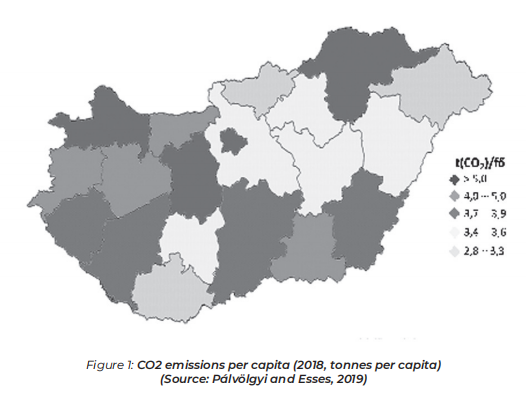
The key question is to identify the regional climate policy “baseline”, i.e., what is the actual “baseline” climate policy performance of each region (region, county)? A key challenge in preventing climate change is the capacity of municipalities and regions to engage in national and international decarbonization efforts. A significant national development in recent years has been the preparation of climate strategies by counties and the capital of Sustainable Energy Climate Action Plans (SECAPs) by many municipalities. The aim of research conducted in 2019 (Pálvölgyi and Esses, 2019) was to explore the domestic “spatial structure” of greenhouse gas (GHG) emissions and visions based on municipal (county, municipality) climate strategies and municipal SECAPs. We found that county-level GHG emissions have a specifictypology, which is explained, among other things, by the region’s economic development and natural and social characteristics.
 
The main drivers of emissions are high population densities, many prefabricated buildings and significant transport traffic. The smallest per capita emissions are found in the more backward and less industrialized small rural areas. Analysing the municipal climate strategy documents, we show that decarbonization performance (i.e., the ability to meet their commitments) leads to a characteristic dichotomy: mitigation interventions in larger cities should focus mainly on the municipal building stock and urban transport, while for many small towns, industry, transit and tourism are the most effective areas for emission reduction. Finally, the 2030 decarbonization commitments of counties and municipalities and planned mitigation measures are analysed. One of the lessons learned is that mitigation measures are often insufficient to achieve the set decarbonization targets. Another conclusion is that mitigation measures do not sufficiently support the transition towards regional sustainability and a circular economy.
 
MUNICIPALITIES, CLIMATE CHANGE IMPACTS AND ADAPTATION: A CASE STUDY ON COUNTY LEVEL DROUGHT-RELATED VULNERABILITY
 
Agriculture is a significant sector in Hungary, and climate change and agricultural drought are particularly important areas of analysis. In a research study (Buzási, Pálvölgyi and Esses, 2021), we investigated the extent to which counties are vulnerable to the expected impacts of drought. The aim of the research is twofold. On the one hand, to develop and apply an indicator-based complex vulnerability assessment model that takes into account both the variability of expected precipitation and evapotranspiration, the different physical properties of soils (drought), their sensitivity and the various adaptive capacities of agriculture (e.g., irrigation) in different counties. On the other hand, we aim to compare the drought vulnerability
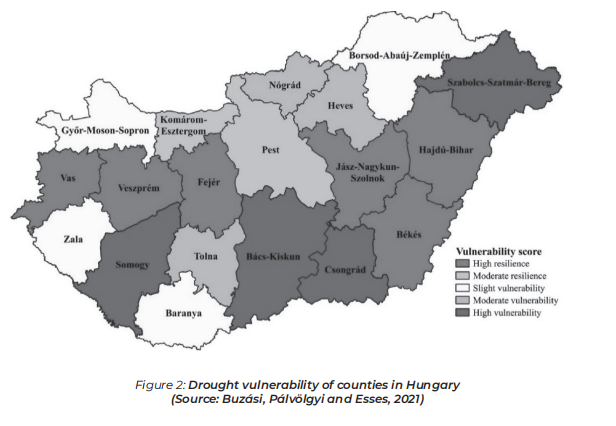
of counties with the drought mitigation adaptation interventions planned by the County Municipalities in their climate strategy. The drought vulnerability assessment model is based on an international methodology and draws, among others, on the National Adaptation Spatial Information System (NATéR) and the agricultural statistics data sources of the Central Statistical Office. Figure 2 shows the complex drought vulnerability of the counties.
 
 
It can be concluded that the most vulnerable counties are located in the south of the country, except for Baranya County, where the topography, soil type and land use justify a more moderate vulnerability. It is noteworthy that Szabolcs-Szatmár-Bereg county, despite being less affected by climate change, shows the highest vulnerability due to a combination of its unfavourable sandy soils and its lower adaptive capacity (relative economic underdevelopment). Our lowland agricultural regions (Jász-Nagykun-Szolnok, Hajdú-Bihar and Békés counties) are resilient (i.e., low vulnerability), mainly due to their excellent soil endowments and significant irrigation development. Central Transdanubian counties are less vulnerable primarily due to more moderate precipitation losses. Still, e.g., Győr-Moson-Sopron county is moderately vulnerable due to its soils and relatively weaker agricultural sector. We compared the drought vulnerability and the planned expenditure on drought measures in the county climate strategies. These expenditures reflect county government climate priorities and preparedness for drought. Counties can be grouped into four types:
 
• “Alert” type counties. The counties of Heves, Tolna and Nógrád are characterized by relatively high vulnerability and moderate preparedness for droughts. These counties are among the least developed regions of Hungary and have a relatively low share of agriculture. Their county climate strategies have not adequately reflected drought’s complex natural and socio-economic risks. It is recommended to strengthen droughtrelated objectives and measures in the revision of the climate change strategies of these counties.
• “Forward planning” type counties. The counties of Bács-Kiskun, Csongrád, Szabolcs-Szatmár-Bereg and Somogy have a solid drought policy, while their vulnerability is in the top quartile. These counties are already suffering from the effects of drought on agriculture, and their policy priorities in drought prevention are well established.
• “Over-estimating” type of counties. Several counties (Pest, Békés, Hajdú-Bihar, Veszprém, Zala and Fejér counties) show low vulnerability but would place a significant
emphasis on drought mitigation. In these counties, it should be considered that over-planned drought mitigation resources could be reallocated to other adaptation measures.
• “Relevant reply” type counties. The strategies of the counties of Jász-Nagykun-Szolnok, Vas, Győr-Moson-Sopron, Borsod-Abaúj-Zemplén, Baranya and Komárom-Esztergom reflect the relatively low vulnerability to drought and their policy responses are relevant. No further review is needed in these cases.
 
Overall, it can be concluded that modelling the drought vulnerability of the counties and comparing it with climate policy interventions can reveal regional differences in climate-related risks.
 
CLIMATE RISK REDUCTION AND THE FEASIBILITY OF PLANNING FOR MUNICIPAL ADAPTATION
 
Disasters with significant consequences, whether industrial or natural, have drawn the attention of researchers and professionals to the importance of mitigation. At the same time, the focus has shifted from mitigation to preparedness and adaptation (Buzási et al., 2022). The main objective of planning local-level preparedness and adaptation processes is to reduce the vulnerability of a given region or settlement to disasters through systematic analysis of the drivers, causes of disasters, the wise use of the environmental resources and land, and preparation for adverse events.
 
To explore the options of preparation and adaptation and the possibilities to minimize risks, it is essential to focus on risk prevention as a first step. In this case, measures should aim at reducing or avoiding potential hazards. The next step is to as sess the vulnerability of the affected area or municipality and, based on the results, plan the necessary interventions, reduce vulnerability and increase the chances of resilience to a likely disaster. Vulnerability is, based on these models, a complex indicator combining expected impacts and adaptive capacity, which can also consider local specificities, thus allowing local authorities to consider the different regional and municipal characteristics. The third step aims to improve the actions, response mechanisms and structures in the event of a disaster to prepare effectively for the response. The final stage of the process focuses on facilitating effective recovery
from a disaster, for which the knowledge, availability and implementation of appropriate recovery mechanisms, resources and structures are essential (Wamsler et al., 2013).
 
Preparedness is the adaptation part of the municipal climate strategy, and it is essential to integrate all sectors (e.g., urban planning) in its work. The adaptation strategy aims to increase the resilience and sustainability of municipalities to various expected impacts by shifting the focus from prevention and control to the importance of learning to live in an ever-changing, occasionally dangerous environment.
 
PLANNING FOR MUNICIPAL PREPAREDNESS AND ADAPTATION
 
The characteristics and endowments of municipalities influence the options for mitigating risks and the development of preparedness and adaptation processes. Rethinking urban planning in light of the climate change challenges is a key element in shaping the effectiveness of plannability. In the case of urban adaptation, a number of different urban characteristics should be taken into account, all of which influence the effectiveness of planning. An approach based on municipal characteristics can be applied in practice and made easily understandable and tangible for local authorities, residents and stakeholders, thus contributing to effective implementation. These characteristics generally vary according to the physical space and environmental, sociocultural, economic and political factors. The physical presence of cities can also be assessed in various ways, such as architectural features, population density, the extent of land cover and vegetation, the spatial structure and characteristics of buildings and infrastructure. These factors can all be part of the characteristics of a city, which can be affected to varying degrees by different risk factors. Many of the environmental, social and economic aspects that distinguish urban areas from rural areas can be found in the physical space-related factors described above. (Pálvölgyi et al, 2016). Among the urban environmental factors, the specific climatic conditions of cities are noteworthy. In this case, the characteristics to focus on in the assessment include precipitation, wind, temperature, air quality, humidity, soil, water bodies, flora and fauna, noise, waste and wastewater. A city’s social and cultural characteristics are fundamentally determined, for example, by the aspects of families, social cohesion, social inequality, social participation, values, health and safety. The characteristics of a city’s economic and governance system may include differences in governance based on particular principles, the availability and accessibility of resources, the features of the institutional system and public services, etc.
 
For effective risk drivers, reducing hazards and vulnerability and developing mechanisms for response and recovery may be the right direction, interacting with the characteristics of a given city. Urban planning and development focusing on preparedness and resilience should rethink institutional, inter-institutional, organizational, educational, technical and other aspects to move towards a liveable, sustainable and future-proof city and settlement. Integrating preparedness and adaptation into settlement planning can also provide adequate public protection.
 
ASSESSMENT OF THE CLIMATE CHANGE PERFORMANCE OF URBAN DEVELOPMENT PROJECTS
 
Urban areas worldwide play a key role in reducing greenhouse gas emissions and adapting to the adverse effects of climate change, so climate-friendly, climate-resilient urban planning is an indispensable component of municipal climate protection. Climate-proofing of urban development projects can reduce complex climate vulnerability and exploit the potential of decarbonization at the project level.
 
A comprehensive methodology and case study was developed to assess the direct and indirect impacts of urban development activities, taking into account the compliance with municipal climate strategies (Buzási, Pálvölgyi and Szalmáné Csete, 2021). The main objective of applying the climate-oriented assessment framework is to assess and improve the climate change performance of interventions for complex rehabilitation and renewal of specific urban areas. The evaluation framework identifies the strengths and weaknesses of the urban development projects under assessment in decarbonization, adaptation and climate adaptation. It will also allow the identification and avoidance of adverse lock-in effects.
 
In a case study, the climate change performance of the complex rehabilitation plan for Goldmann Square and its surroundings in the 11th district of Budapest was assessed in terms of compliance with 16 evaluation criteria based on the objectives of the Budapest Climate Strategy. The assessment framework is based on a methodology widely used in the literature and developed to identify complex environmental, sustainability and climate change performance indicators. Although the analysis has focused on the “Budapest” context, the methodology can be easily adapted to other municipalities by focusing on local (even city-to-city) climate strategy aspects. The methodology allows for formulating recommendations to im
prove the climate performance of specific urban planning projects, thus achieving climate change mainstreaming in practice. As municipalities play an exceptional role in the development of “good climate governance”, the following general recommendations for urban planners and decision-makers can be made
 
• Recommendations for urban planners. It is essential to treat expected climate change as an implementation risk in local development plans. It also means that these plans need to consider the changing climate and physical and regulatory risks, for which the climate performance assessment method can be used as a “quick-test” tool. Climate performance assessment should be used early in development planning to avoid “lock-in” effects that could lead to costly corrections later on. As the climate performance of a specific development plan is highly dependent on local specificities, the assessment criteria (i.e., against which the climate-proofing and climate resilience of the plan is “measured”) should be based on the local (regional, municipal, urban) climate strategy.
• Recommendations for mayor’s offices, municipal administration and institutions. On the one hand, local authorities’ climate change objectives and commitments must be incorporated into their strategy and legislation, particularly in their budget planning, management of municipalities and public services, and efforts to strengthen public participation. On the other hand, preparing or revising urban climate change strategies, programs and action plans should adequately reflect the critical issues of climate-related assessment of urban development projects.
 
A key success factor for municipal climate policy is a meaningful dialogue between stakeholders (i.e., people living and working in the municipality, NGOs, development planners, decision-makers, etc.). It has also been shown that the developed climate-oriented assessment framework can effectively facilitate stakeholder dialogue and improve social awareness and attitudes toward climate change.
 
CLIMATE IMPACT ASSESSMENT OF MUNICIPAL LEGISLATION, STRATEGIES AND PLANS
 
Integration is a low-cost, effective tool for climate action in local governments; it is strongly recommended by several international organizations (e.g., Covenant of Mayors, ICLEI, Under2). A climate impact assessment is a municipal climate policy’s primary planning and decision-support tool. Its aim is to provide a climate screening of the municipality’s activities and lay the foundations for climate-friendly and climate-resilient municipal action. In essence, climate policy objectives should “permeate” the whole of the municipality’s activities, integrating, among other things, the following areas:
 
• Municipal regulations and strategies (e.g., business development, energy management, transport development, green space management, environmental protection, education, social relations, etc.)
• Urban development and planning (e.g., zoning plans, building regulations, infrastructure development)
• Municipal tenders, support mechanisms (environment, culture, grassroots sports, social support)
• Operation of municipal institutions and public utilities (e.g., education, health, sports and cultural institutions, public sanitation, park maintenance, etc.)
• Operation of the mayor’s office, its activities (e.g., investments, public procurement, tenders (where the municipality is a tenderer), operating rules)
• The adequacy of municipal climate policy should be assessed in decarbonization, adaptation and awareness-raising “dimensions”, in the following impact categories:
• heating energy use
• electricity consumption
• electricity generation
• transport, transport infrastructure
• health risks associated with heat waves
• increased frequency of sudden rainfall events, flood-risk
• green spaces, natural values, wildlife
• tourism
• general climate awareness
• energy awareness
 
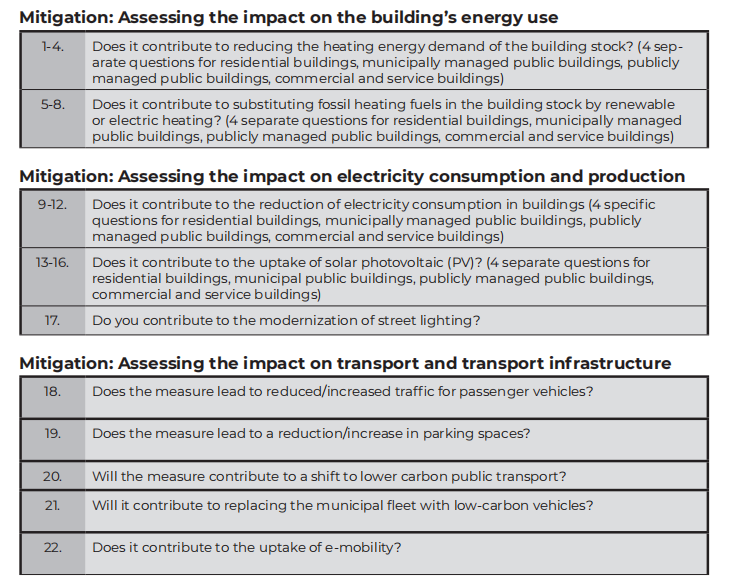
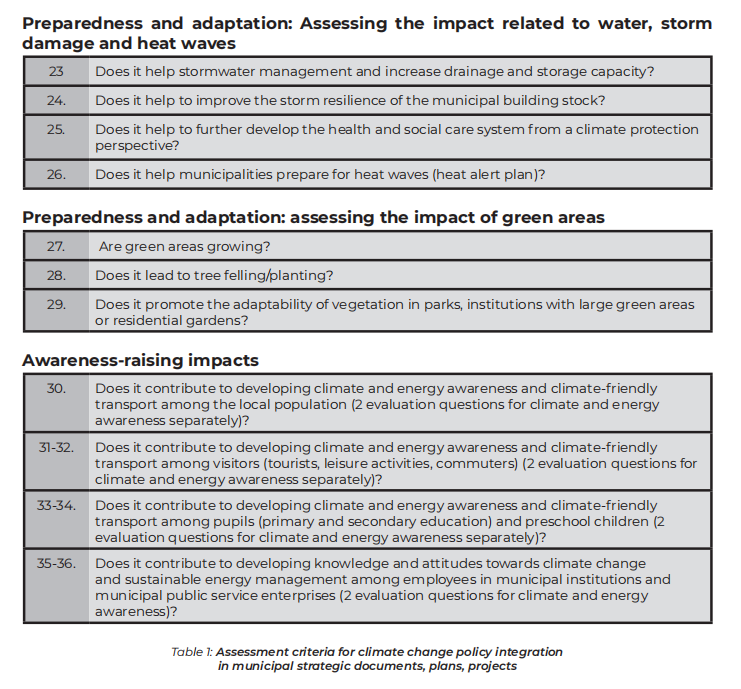
In a joint peer review meeting, the document under evaluation will be assessed against the criteria in the table below. The 36 “evaluation questions” form the rows of the scoreboard-type evaluation matrix. The columns of the matrix are made up of the rating assigned to each row, e.g., on a 1 to 5 point scale. The overall score reflects the degree of climate integration and provides a way to track progress over time.
 
 
CONCLUSIONS
Success factors for municipal climate strategies
 
Based on the national and international scientific literature, the following success factors can be identified:
 
• The need to reduce hazards. In formulating their climate protection strategy, municipalities react reactively to an event or damage that has already occurred. It may encourage municipalities to introduce preventive measures. For example, this can be seen in municipal water management (e.g., stormwater disposal).
• Cost reduction. Cost savings can also be a significant incentive for municipalities. For example, saving energy can reduce expenditure, but adaptation can also significantly reduce future spending on damage repair.
• Reputational benefit. Municipalities successful in climate action gain a national or cross-border reputation, which can sometimes motivate others.
• Past experiences, good practices. The municipality has previously implemented measures that can be linked to or form the basis of a climate programme (e.g., environmental, energy efficiency). At least a designated person in the municipality is committed to the programme and helping implement it.
• Institutional staffing conditions. The municipality has institutionalized climate protection and employs at least one person to coordinate and organize the climate programme.
• Networking. It involves local partners and actors, linking up with organizations of climate-friendly municipalities, which can facilitate the flow of information and the exchange of experience. Networking can also help to stimulate local actors (citizens, businesses, NGOs) to take climate initiatives.
• Funding. Although municipal climate protection interventions are not always costly, they require some secure – not contingent and therefore predictable – funding. Public and EU funding has a key role to play in ensuring that the necessary financial conditions are in place. International practice shows that municipalities running a climate programme often set up climate funds.
• Develop a municipal climate policy. Strategic planning for climate protection in the municipality (setting up a climate strategy and integrating climate policy objectives into other strategies and development plans). Introduction of planning and regulatory instruments (urban development plans, building codes, transport regulation, utility tasks, etc.).
 
RECOMMENDATIONS FOR THE IMPLEMENTATION OF MUNICIPAL CLIMATE CHANGE STRATEGIES
 
The following general recommendations are made for municipal and regional climate actions:
 
1. It is recommended that the need to reduce carbon dioxide emissions and other greenhouse gases is considered in preparing and revising local strategic documents (e.g., spatial and urban development plans, integrated urban development strategy, environmental programme, sustainability strategy, etc.). In many cases, this will not mean introducing new measures but examining and quantifying the targets and orientations set out in the local/regional climate strategy in the strategy documents. The county climate platforms should develop mechanisms to coordinate climate change interventions at the local level.
2. Local and regional economic development strategies should identify and consider locally relevant activities (local green economy) that can significantly contribute to improving local competitiveness and economic growth in the face of increasingly stringent environmental and climate protection standards.
3. In all districts and municipalities with more than 50,000 inhabitants, it is recommended that a climate and energy officer be appointed within the district’s working structure
(mayor’s office, district working structure, etc.).
4. Setting an example at the local (municipal) level is essential by launching complex building energy and climate protection programmes in municipalities, covering a wide range of residents and public institutions.

References

1. Buzási A., Pálvölgyi T., Szalmáné Csete M. (2021). Assessment of climate change performance of urban development projects - Case of Budapest, Hungary. Cities, Volume 114, 103215, ISSN 0264-2751, https://doi.org/10.1016/j.cities.2021.103215.

2. Buzási A., Pálvölgyi T. and Esses D. (2021). Drought-related vulnerability and its policy implications in Hungary. Mitig Adapt Strateg Glob Change 26, 11 (2021). https://doi.org/10.1007/s11027-021-09943-8

3. Buzási A., Szimonetta Jäger B., Hortay O. (2022). Mixed approach to assess urban sustainability and resilience - A spatio-temporal perspective. City and Environment Interactions, Volume 16, 100088, ISSN 2590-2520, doi.org/10.1016/j.cacint.2022.100088.

4. IPCC, 2022: Climate Change 2022: Impacts, Adaptation, and Vulnerability. Contribution of Working Group II to the Sixth Assessment Report of the Intergovernmental Panel on Climate Change [H.-O. Pörtner, D.C. Roberts, M. Tignor, E.S. Poloczanska, K. Mintenbeck, A. Alegría, M. Craig, S. Langsdorf, S. Löschke, V. Pörtner, D.C. Roberts, M. Tignor, E.S. Poloczanska, K. Mintenbeck, A. Alegría, M. Craig, S. Langsdorf, S. Löschke, V. Möller, A. Okem, B. Rama (eds.)]. Cambridge University Press. Cambridge University Press, Cambridge, UK and New York, NY, USA, 3056 pp., doi:10.1017/9781009325844.

5. Pálvölgyi, T., Czira, T., Fancsik, T. (2016). Applying science-based decision-preparatory information in “climate-proof” public policy planning. In: Knowledge Sharing, Adaptation and Climate Change. Research and Development Results of the Hungarian Geological and Geophysical Institute for the Establishment of the National Adaptation Geoinformatics System. Eds. T. Pálvölgyi and P. Selmeczi Hungarian Geological and Geophysical Institute, Budapest.

6. Pálvölgyi T. and Esses D. (2019). Regional characteristics of greenhouse gas emissions and decarbonization options in Hungary. DETUROPE - THE CENTRAL EUROPEAN JOURNAL OF REGIONAL DEVELOPMENT AND TOURISM, Vol. 11 Issue 3 2019 ISSN 1821-2506.

WEBOGRAPHY

1. Wamsler C, Brink E., Rivera C. (2013). Planning for climate change in urban areas: from theory to practice, Journal of Cleaner Production, Volume 50, 2013, Pages 68-81, ISSN
0959-6526, https://doi.org/10.1016/j.jclepro.2012.12.008.

2. ACFM, 2018: Guidance for the development of climate strategies for municipalities Association of Climate Friendly Municipalities - Hungarian Mining and Geological Survey (KEHOP-1.2.0-15-2016-00001, “Provision of technical support and coordination in local climate strategies”) http://klimabarat.hu/images/tudastar/8/kepek/KBTSZ_modszertanfejl_VaROS_180226.pdf

PDF Version

Authors

Lajos Kovács

Tamás Pálvögyi

Keywords

MUNICIPAL CLIMATE CHANGE POLICY MITIGATION ADAPTION CLI MATE VULNERABILITY RISK REDUCTION

🛡️ Licence and usage rights

This work is published under the Creative Commons Attribution 4.0 International (CC BY 4.0).


Authors retain copyright over their work.


Use, distribution, and adaptation of the work, including commercial use, is permitted with clear attribution to the original author and source.

Interested in Similar Research?

Browse All Articles and Journals